
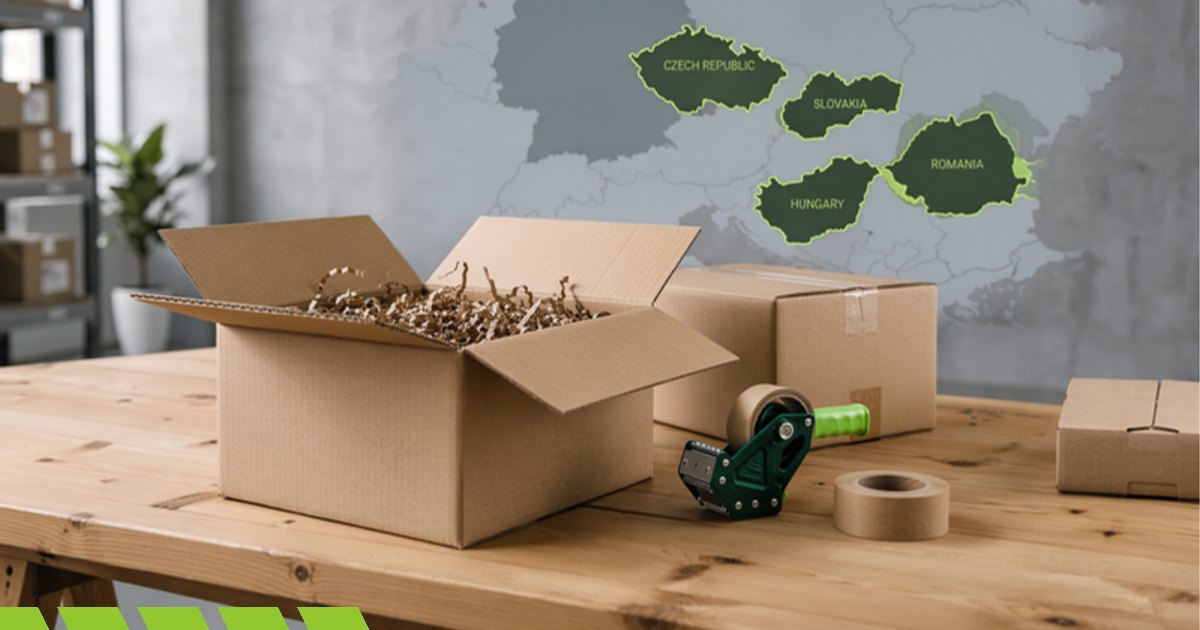
Selling online in several European markets does not mean environmental obligations can be handled with a single process. A Polish company shipping products to Czechia, Slovakia, Romania and Hungary may be subject to four different EPR registration and reporting procedures.
The differences concern not only how obligations are fulfilled, but also how often reports are due, what data is required and how cooperation with producer responsibility organisations works. Changes resulting from the EU Packaging and Packaging Waste Regulation (PPWR), applicable since 12 August 2026, add another layer.
We look at what online sellers active in these four markets should pay attention to.
Packaging EPR in cross-border sales. Why does each country need a separate analysis?
Extended Producer Responsibility (EPR) means that companies placing certain products or packaging on the market help finance the management of the waste they generate.
For online sellers, obligations may cover both product packaging and the additional materials used to fulfil orders, such as shipping boxes, envelopes, film and void fill.
The key question is who is responsible for a given piece of packaging. It will not always be the company that physically manufactured it. The sales model, the company's role in the supply chain and the country where the packaging ends up all matter.
The PPWR, Regulation (EU) 2025/40, harmonises some of the rules on packaging and packaging waste in the European Union. It does not, however, create a single European system for EPR registration and settlement.
That is why a business selling to several countries should determine separately for each one:
- whether it acts as a producer under EPR rules in that market;
- which packaging it is responsible for;
- which registration and financial obligations it must fulfil;
- what data is required for reporting and by which deadlines;
- whether an authorised representative must be appointed.
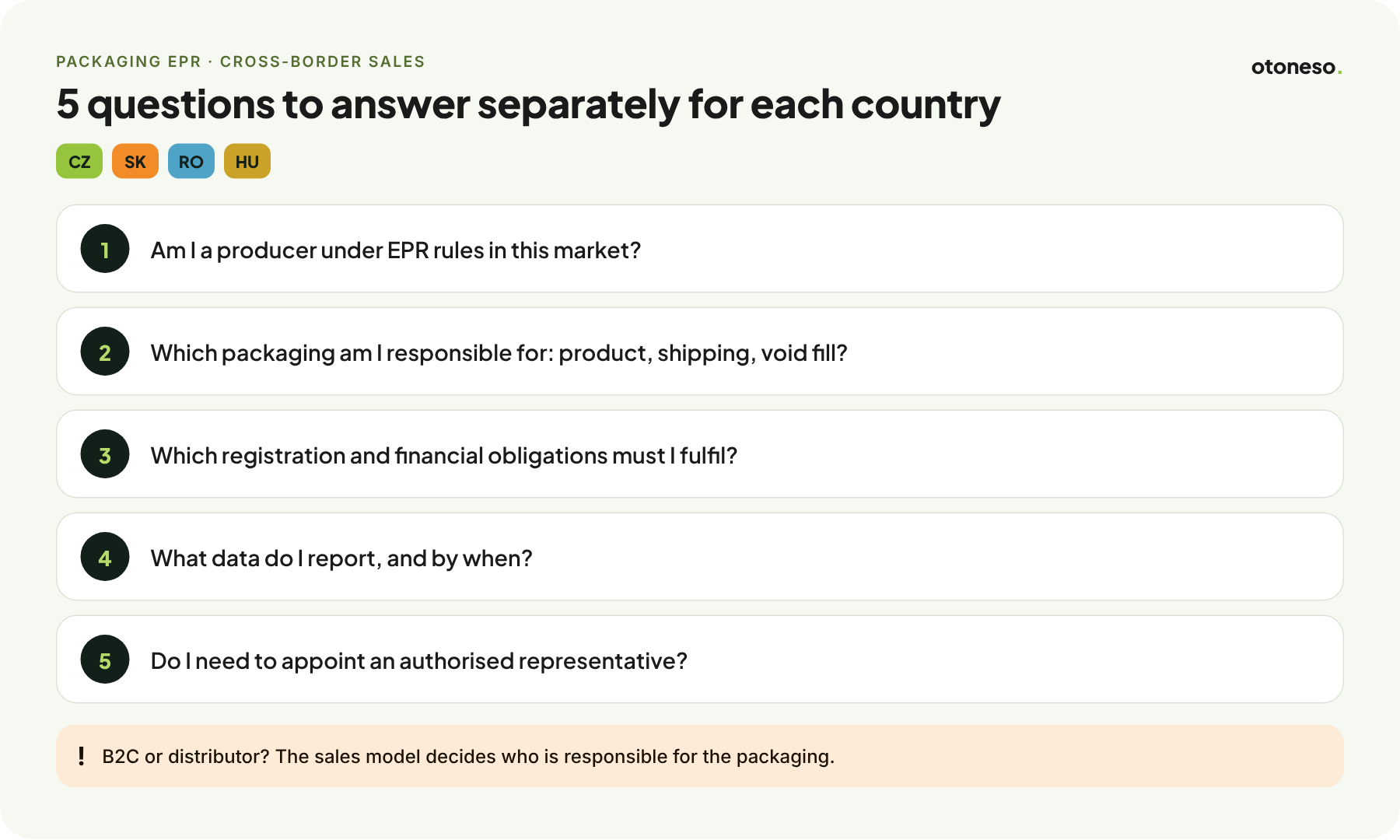
It is particularly important to distinguish between selling directly to end users and supplying a local distributor. In each case, responsibility for the packaging may be assigned to a different party.
Czechia: small packaging volumes no longer mean an EPR exemption
The Czech packaging EPR system relies largely on collective compliance through the EKO-KOM organisation. The law also allows individual compliance, but this requires meeting specific statutory conditions.
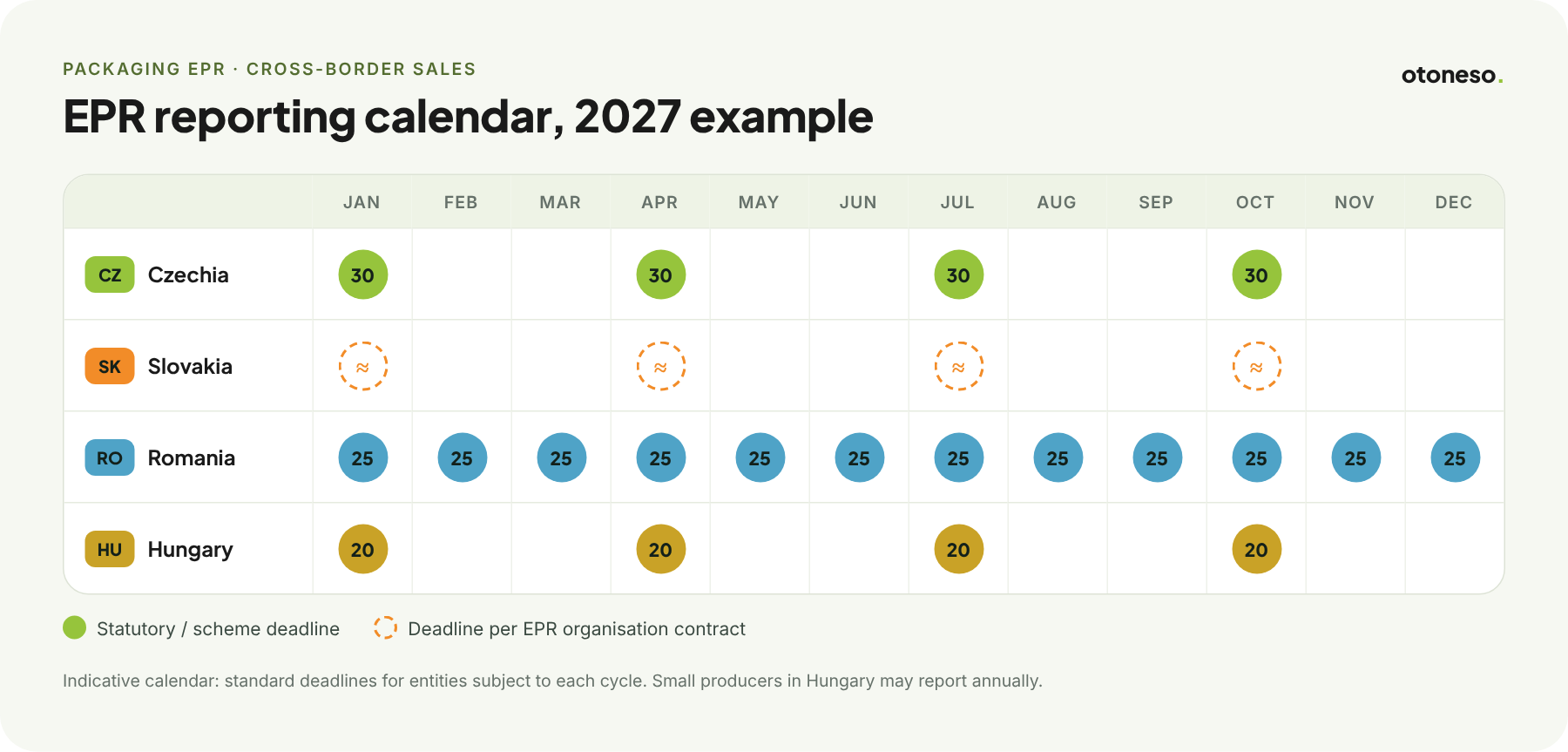
Companies using EKO-KOM report data on packaging placed on the Czech market quarterly, by the 30th day of the month following the end of the quarter.
Reporting covers not only packaging weight but also a breakdown by material and category. The Czech system distinguishes, among others, between sales and industrial packaging and reusable packaging.
What to watch for in EPR registration and reporting in Czechia
Before you start selling to Czechia, check whether your company is subject to EPR obligations and which packaging it is responsible for. The sales model and the company's role in the supply chain are decisive.
A small sales volume does not automatically mean an EPR exemption. From 12 August 2026, the previous Czech exemption for up to 300 kg of packaging per year and turnover of up to CZK 25 million no longer applies to EPR obligations arising from the PPWR.
Companies should pay particular attention to:
- Scope of responsibility: obligations may cover both product packaging and materials used for shipping.
- Packaging categories: a simple total of paper, plastic or glass weight may not be enough for correct reporting.
- Deadlines: in the EKO-KOM system, reporting is quarterly, by the 30th day of the month after the quarter ends.
- Up-to-date obligations: companies that previously relied on the national exemption should reassess their situation now that the PPWR applies.
In practice, it is especially important to correctly define the scope of responsibility and prepare data in the breakdown required by the Czech system. Companies should not base their assessment solely on the rules in force before August 2026.
Slovakia: registration alone is not enough. Watch representation and reporting
In Slovakia, companies subject to packaging EPR obligations must register in the national register of producers. For packaging that becomes municipal waste, waste management obligations are generally fulfilled through authorised producer responsibility organisations. Individual compliance is allowed in certain cases.
Companies working with such organisations must keep packaging records and provide the data needed for settlement. Quarterly reporting is common in practice, but the specific deadlines follow from the terms of cooperation with the given organisation.
Records should cover the quantity and weight of packaging placed on the Slovak market, broken down by material. Reporting data to an EPR organisation must be distinguished from statutory reporting to the authorities.
What to watch for in EPR registration and reporting in Slovakia
Before you start selling, first determine whether your company is a packaging producer under current law. It matters a great deal whether products go directly to end users or through a local distributor.
The key issues are:
- Authorised representative: foreign companies covered by this requirement must appoint an appropriate representative. The scope of the obligation should be checked for the specific sales model.
- Responsibility for packaging: determine who is responsible for product packaging and for materials used for shipping.
- Reporting deadlines: data provided to EPR organisations may be settled quarterly. The applicable schedule should be confirmed under the terms of cooperation.
- Changes after the PPWR: from 12 August 2026, EU rules for identifying the EPR producer apply. Companies with an earlier registration should check whether they still assign responsibility for packaging correctly.
In Slovakia, the distinction between B2B sales and direct sales to end users is particularly important. The sales model can determine which party is responsible for the packaging, and therefore the scope of registration and reporting.
Romania: monthly reporting, even when working with an EPR organisation
The Romanian packaging EPR system provides for compliance through authorised producer responsibility organisations. In cases defined by law, individual compliance is also possible. However, it is not a freely available alternative for every type of packaging.
Companies covered by the rules must also meet record-keeping and declaration obligations towards the national environmental administration.
A distinctive feature of the Romanian system is monthly declarations. Entities subject to this obligation generally submit data by the 25th day of the month following the month concerned.
Packaging records should include weight, material type and category. Romanian rules distinguish, among others, between primary, secondary and transport packaging.
What to watch for in EPR registration and reporting in Romania
Before you start selling to Romania, determine who is responsible for the packaging placed on this market and which obligations remain with your company even if you use an EPR organisation.
Pay attention to the following:
- Monthly declarations: entities subject to this obligation must prepare data more often than in standard quarterly systems.
- Packaging type: records must be broken down into the relevant categories, including primary, secondary and transport packaging.
- Working with an EPR organisation: transferring certain recovery and recycling obligations does not automatically release you from your own records and declarations.
- Individual compliance: this option applies only in cases defined by law, so do not assume it is available for all packaging you place on the market.
In practice, the key is to establish which obligations the EPR organisation fulfils and which remain with the company. With monthly declarations, preparing data regularly, rather than reconstructing it at the end of the quarter, becomes especially important.
Hungary: mandatory MOHU registration and specific reporting rules
The Hungarian packaging EPR system is built around the national operator MOHU. In the standard model, obligated companies register both in the operator's system and with the competent waste management authority.
These are two separate steps in the process. The rules do, however, provide exemptions from authority registration for certain categories of producers.
In the standard model, data on products and packaging covered by EPR is reported quarterly to the competent waste management authority, by the 20th day of the month following the end of the quarter. This information then forms the basis for MOHU's fee settlement.
A distinctive element of the system is classification using eight-digit KF codes. This means that information on total packaging weight broken down by material may not be enough to prepare a correct report.
What to watch for in EPR registration and reporting in Hungary
Before you start selling, determine whether your company acts as an obligated EPR producer and which packaging should be included in the settlement.
The key issues are:
- MOHU registration: in the standard model, separate formalities are required in the operator's system and with the competent authority. Exemptions exist for certain producers.
- KF codes: correctly assigning EPR products to the right categories matters for reporting and fee calculation.
- Reporting deadlines: as standard, data is reported quarterly, by the 20th day after the quarter ends. Eligible small producers may use certain simplifications, including annual reporting.
- Authorised representative: foreign online sellers covered by this requirement must take the Hungarian representation rules into account.
In Hungary, it is particularly important to distinguish between registration, record-keeping and reporting. Data must be prepared according to the local classification, as it affects not only reporting but also the amount of EPR fees.
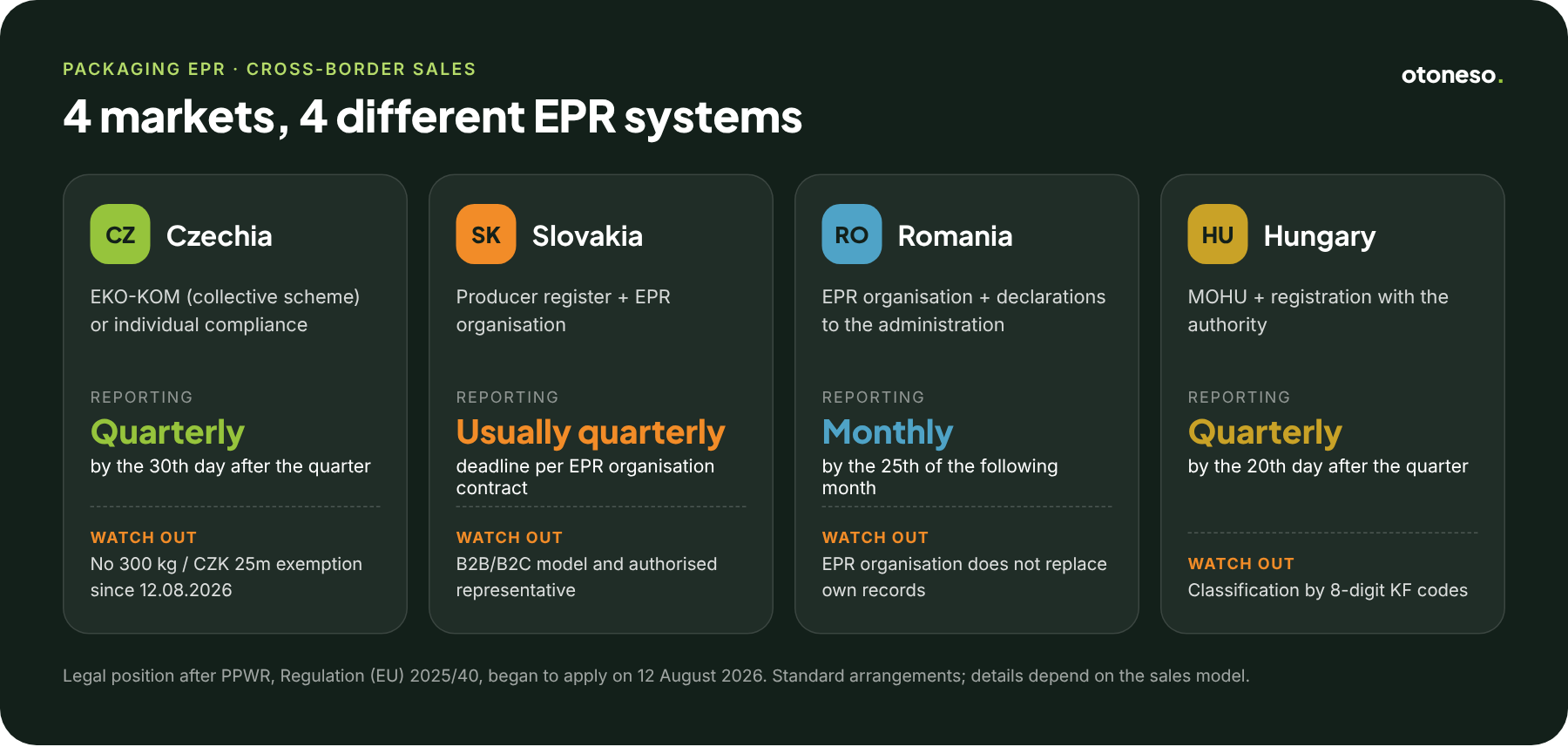
EPR in Czechia, Slovakia, Romania and Hungary: comparison of key obligations
Although all four countries apply EU rules on extended producer responsibility, the way packaging obligations are fulfilled still differs.
The table shows standard arrangements. The scope of obligations and deadlines may differ depending on the company's status, sales model and EPR compliance arrangements.
Example: one online shop, four different sets of requirements
Suppose a Polish online shop sells home furnishings directly to consumers in Czechia, Slovakia, Romania and Hungary. Each order ships in a cardboard box with paper void fill, and the product itself has additional unit packaging.
For example, in one month the shop fulfils 500 orders to Czechia and 300 to Romania. The number of shipments alone, however, is not enough to determine the weight of packaging to be settled.
The company must take into account, among other things, the materials used, their weight and which packaging elements it is responsible for in each market.
In Czechia, the right data breakdown for quarterly reporting matters. In Slovakia, correctly identifying the responsible party and the representation rules is also important. In Romania, the shorter declaration periods must be taken into account, and in Hungary the specific EPR classification.
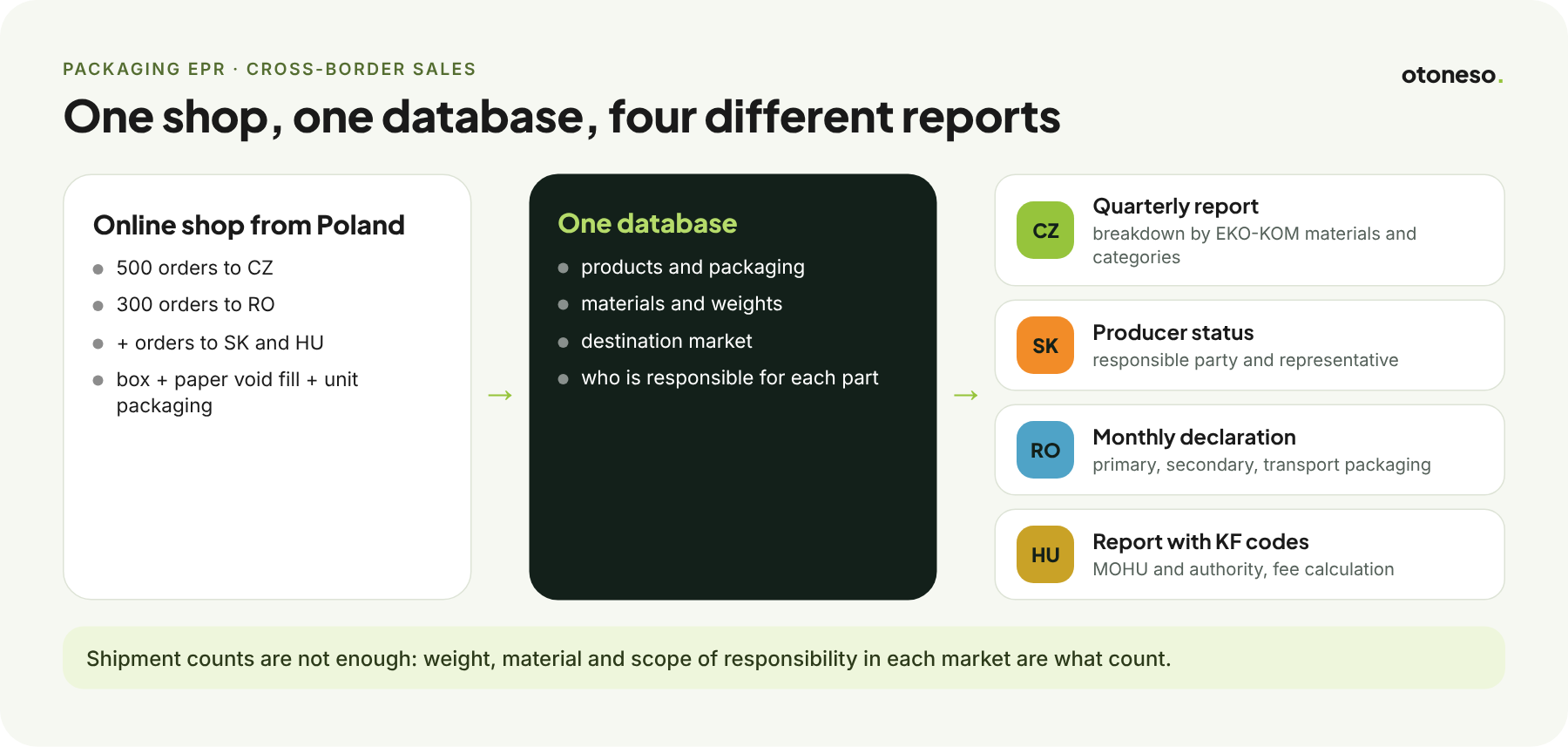
A single database of products and packaging can be the starting point for settlements in several markets, but the data must be prepared according to each country's requirements.
The most common mistakes in EPR registration and reporting abroad
Selling in several European markets means taking different registration and reporting rules into account. The most common mistakes are:
- One registration for the whole EU: EPR obligations must be checked separately for each country.
- Identical reporting everywhere: countries use different deadlines, categories and data requirements.
- Misidentifying responsibility: obligations depend, among other things, on the company's role and sales model.
- Outdated information on the rules: changes resulting from the PPWR may affect existing exemptions and settlement rules.
- Assuming the EPR organisation takes over all obligations: the company may still be responsible for records and data submission.
That is why, before entering a new market, it is worth checking both the registration requirements and the rules for subsequent reporting.
How to simplify EPR reporting when selling to several countries
Different deadlines, packaging categories and data requirements make EPR reporting across several markets time-consuming. Especially when a company has to compile order information, calculate packaging weights and prepare separate summaries on its own.
The solution is to organise data in one place and automate repetitive tasks. This is exactly what eprPilot helps with, a tool that supports businesses in organising their EPR obligations.
eprPilot lets you:
- Collect sales data – import order information from supported sales systems.
- Calculate packaging weights – support in determining packaging quantities assigned to each market.
- Prepare EPR reports – organise the data needed for settlements.
- Track deadlines – easier control of obligations and upcoming reporting periods.
This allows sellers to reduce manual compilation of data from many sources and prepare settlements more efficiently. Centralised information also makes later verification and updates easier.
More information: eprpilot.com
One shop, several countries. How to stay EPR compliant
Selling to Czechia, Slovakia, Romania and Hungary requires a separate review of obligations, but it does not have to mean keeping four independent sets of records in separate spreadsheets.
The foundation is determining which packaging the company is responsible for in each market and organising the data needed for reporting.
Otoneso helps businesses identify and fulfil their EPR obligations, while eprPilot supports day-to-day work with data and report preparation. This combination of expert support and technology makes it easier to manage environmental obligations in cross-border sales.