
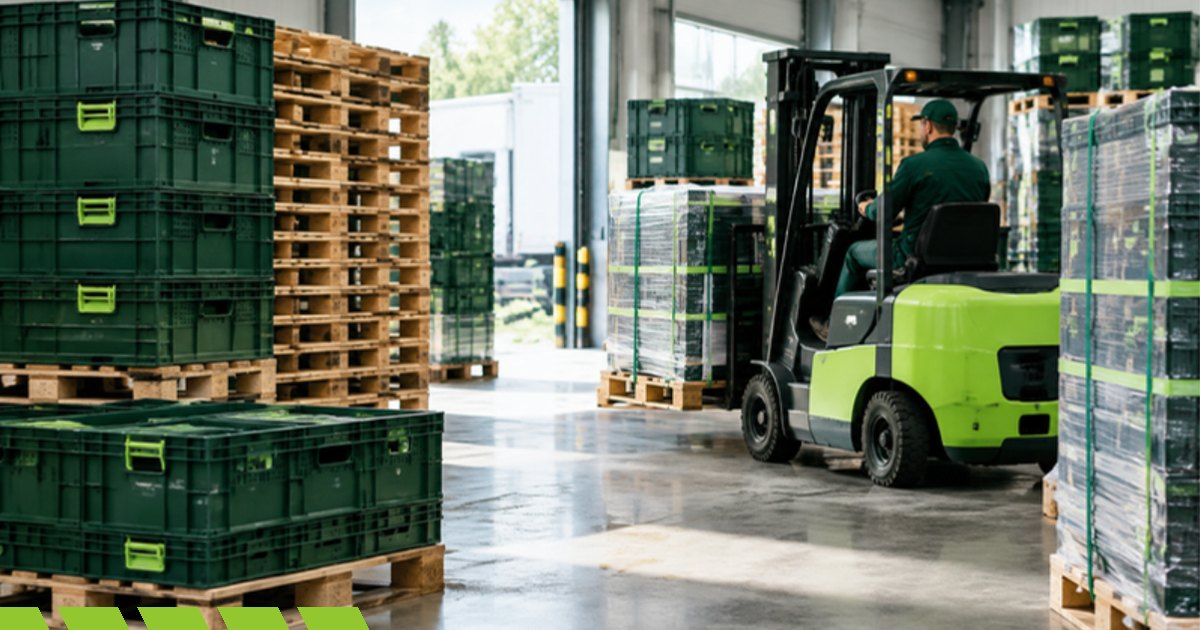
When people talk about PPWR, they usually think of retail packaging or e-commerce shipping boxes. Yet Regulation (EU) 2025/40 also covers what the end customer never sees: pallets, crates, IBCs, drums, stretch film and straps that move every day between manufacturers, warehouses, logistics providers and stores.
PPWR is a regulation, so it applies directly in every EU country. It has applied since 12 August 2026, and the reuse obligations for transport packaging start in 2030. That is less time than it seems, because changing packaging systems in logistics takes investment, partner agreements and new processes.
Which transport packaging PPWR covers
The reuse rules (Article 29 PPWR) apply to packaging used to transport products, of any material and size, including:
- pallets, crates and foldable plastic boxes,
- boxes, trays, pails, drums and canisters,
- intermediate bulk containers (IBCs) for liquids and bulk goods,
- film and straps that stabilise and protect goods on pallets.
An important exception: the reuse targets do not cover cardboard boxes. Packaging for dangerous goods, for large machinery and equipment, and flexible packaging in direct contact with food are also excluded. Micro-enterprises do not have to meet these targets.
Reuse targets: 2030 and 2040
- From 1 January 2030, at least 40% of the transport packaging a company uses must be reusable packaging within a system for re-use.
- By 2040, PPWR sets a further aim of at least 70%.
- Transport between your own sites and linked companies in the same member state has a higher target, in principle 100% reusable packaging.
Always check the details, including exact scope and exemptions, in the current text of Article 29 and the implementing acts, as the European Commission is still clarifying how they apply.
Re-use systems, pallet pooling and B2B deposits
Buying a sturdier pallet is not enough. PPWR requires reusable packaging to circulate in a system for re-use, with clear rules for return, cleaning, repair and withdrawal of worn items. Three models work well in practice:
- Pallet and crate pooling. An external operator supplies, collects and services the packaging. You pay per rotation instead of owning a packaging fleet.
- Your own closed loop. Packaging circulates between your sites or regular partners, such as a parts supplier and a factory.
- B2B deposit. The recipient pays a deposit on a crate or container and gets it back on return. A simple incentive to keep packaging coming back.
Data is key in every model: how many items are in circulation, how many rotations they make and how many drop out. Without it, it is hard to show that the 40% target is met.
Empty space and pallet wrap
From 2030, PPWR also limits empty space in grouped, transport and e-commerce packaging: as a rule it may not exceed 50%. For logistics this means better matching boxes to goods and rethinking fillers. Stretch film deserves a look too: reusable straps, nets and pallet covers can cut single-use material and help meet the targets.
Who is responsible in the supply chain
Article 29 obligations fall on the operator that uses transport packaging to move products, not only on the packaging manufacturer. In chains with several parties, such as a manufacturer, a 3PL and a carrier, contracts should state who provides reusable packaging, who records rotations and who supplies data for reporting. Unclear contracts are the most common source of problems during inspections.
Penalties for PPWR breaches are set by member states. National implementing rules are still being prepared in many countries, but you should already assume that authorities will check both the share of reusable packaging and the documentation.
How to prepare: a plan for the coming months
- Take stock of your transport packaging: types, materials, quantities and routes.
- Mark what is excluded (e.g. cardboard, dangerous goods) and what counts towards the targets.
- Calculate your current share of reusable packaging and compare it with the 40% target.
- Choose a model: pooling, closed loop or B2B deposit, separately for different routes.
- Update agreements with 3PLs and carriers so they clearly set out responsibility and data flows.
- Collect rotation data from now on, ideally in a system you can link to EPR reporting.
What next
Transport packaging has so far been treated as an operating cost. PPWR turns it into a compliance area that has to be planned, documented and reported. Companies that start now can spread investment over time and will have data proving compliance by 2030.