
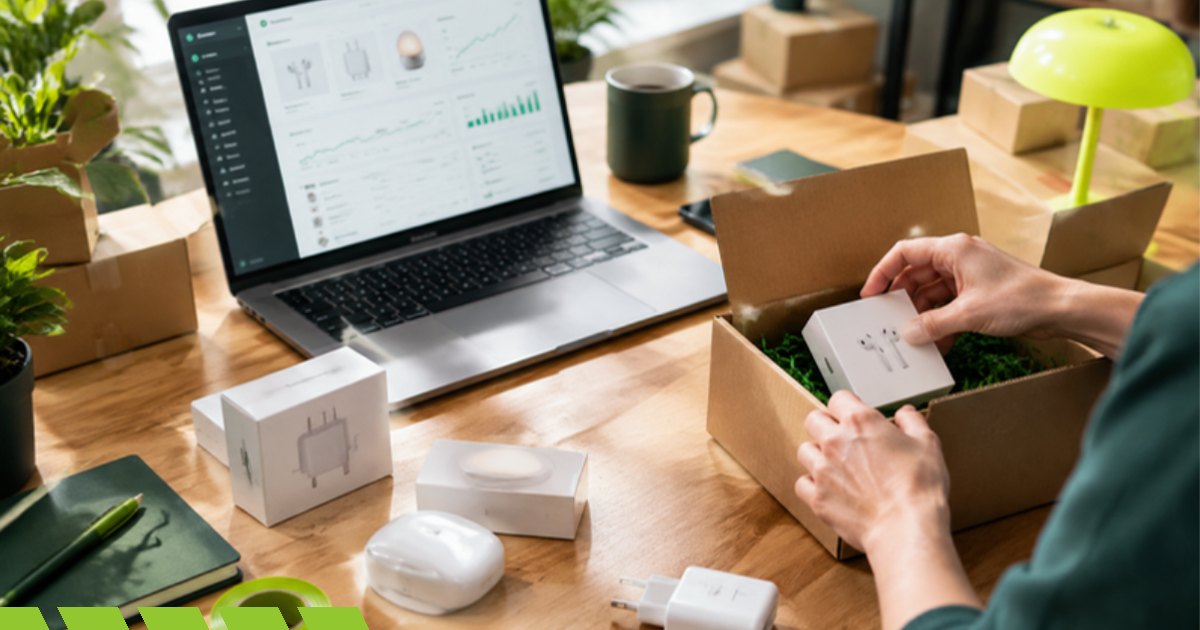
Selling headphones, chargers, LED lights or battery-powered toys on Amazon? That is electrical and electronic equipment (EEE), and placing it on the EU market comes with WEEE obligations. Amazon increasingly checks them itself and can block listings when the registration number is missing in Seller Central.
Here is when WEEE applies to Amazon sellers, where Amazon asks for a number and how to prepare step by step.
What WEEE is and who it applies to
WEEE (Waste Electrical and Electronic Equipment) is an extended producer responsibility (EPR) system for end-of-life electrical and electronic equipment, based on Directive 2012/19/EU. Each country implements it its own way, with its own register, reporting deadlines and fees.
The producer is the company that first places the equipment on the market of a given country. In e-commerce that is very often the seller, including when goods are bought from a non-EU supplier or sold under your own brand. If you ship products to customers in Germany, you place them on the German market, even if your company and warehouse are in Poland.
Which products count as EEE
The scope is wider than many sellers expect. In practice it covers almost anything that needs mains power or a battery to work, for example:
- consumer electronics: headphones, speakers, power banks, chargers, cables,
- lighting: LED bulbs and strips, lamps, torches,
- household appliances and tools: hair dryers, blenders, drills, vacuum cleaners,
- electronic toys, gadgets with LEDs, light-up clothing and shoes.
Batteries supplied with the equipment fall under a separate EPR system (BATT), and the packaging you ship in falls under another. One product can therefore need three registrations in one country.
Where Amazon asks for a WEEE number
In several countries the law requires marketplaces to check that sellers are registered. That is why Amazon asks for EPR registration numbers in Seller Central, in its EPR compliance section:
- Germany. Registration with stiftung ear and a WEEE-Reg.-Nr. DE. A company without a German establishment must appoint an authorised representative (Bevollmächtigter). The number should also appear in listings and on invoices.
- France. Membership in a producer responsibility organisation (éco-organisme) and a unique identifier (UID). If the seller does not provide it, the marketplace may charge the eco-fee itself and pass it on to the seller.
- Spain. Entry in the equipment producers register (RII-AEE) and a number entered in Seller Central.
If Amazon does not ask for a number in a country, the obligation still applies. In Poland an equipment producer needs a BDO entry, and similar registers exist in Italy, Austria, the Netherlands and Czechia, among others.
FBA and Pan-European: watch the warehouses
With FBA, and Pan-European FBA in particular, Amazon moves your stock to warehouses in different countries. Selling from a warehouse in Germany, France or Spain means placing equipment on that country's market, so WEEE obligations arise where the goods go and where customers live. Before you switch on a new marketplace or programme, check that you are registered there.
What happens without registration
- Blocked listings on Amazon in the country where the number is missing.
- Fees charged by the marketplace on the seller's behalf (e.g. in France), often higher than under your own contract.
- Administrative fines. In Germany they can reach EUR 100,000, and competitors can also send cease-and-desist letters (Abmahnung).
How to prepare, step by step
- Review your range: which products are EEE, which contain batteries, what packaging they use.
- List the countries you sell to or where Amazon stores your stock.
- Register in each country and appoint an authorised representative where required.
- Enter the numbers in Seller Central and, where required, in listings and on invoices.
- Report volumes and pay fees on each country's schedule: monthly, quarterly or yearly.
- Update categories when you add new products or marketplaces.
Summary
WEEE on Amazon is not a formality to put off. Without a registration number your listings disappear from search, and every new marketplace multiplies the obligations. The simplest setup is one partner who handles registrations and reports in every country.