
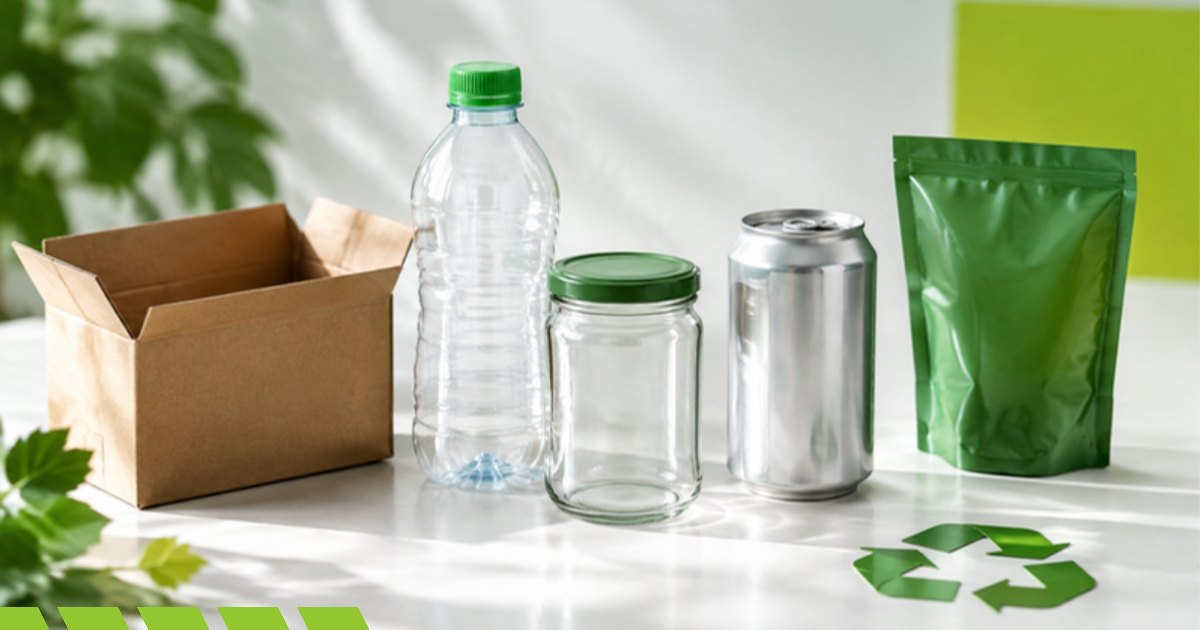
From 1 January 2030 only recyclable packaging may be placed on the EU market. The PPWR, Regulation (EU) 2025/40, measures this with recyclability grades A, B and C. Packaging below grade C will no longer be allowed. This guide explains how the grades work, what lowers a packaging grade and where to start.
Packaging recyclability: a core element of the PPWR
The PPWR replaces the Packaging Directive and applies directly in every EU country. Recyclability is one of its key requirements, alongside minimum recycled content, packaging minimisation and new labelling. It covers almost all packaging: sales, grouped, transport and e-commerce packaging, whatever the material.
For companies this means one thing: packaging must be assessed at the design stage, not only when reporting to an EPR scheme.
PPWR recyclability grades: A, B and C
The grade depends on how much of the packaging weight can actually be recycled in industrial practice. The regulation sets the thresholds in Annex II:
- Grade A (at least 95%): the highest level. The safest from a regulatory point of view and usually the cheapest in EPR fees.
- Grade B (at least 80%): a good level, still accepted after 2038.
- Grade C (at least 70%): the minimum allowed from 2030, but only temporarily. From 2038 it is no longer enough.
- Below grade C: the packaging is considered not recyclable. From 2030 it cannot be placed on the market.
The detailed design-for-recycling criteria for each material will be set by the Commission in delegated acts. The direction is already clear: a single material, easy sorting and no additives that disrupt recycling.
Key dates
- 1 January 2030: packaging must reach at least grade C,
- from 2030: EPR fees are to be modulated by recyclability grade, so weaker packaging will cost more,
- 2035: packaging must also be recycled “at scale”, meaning it is actually collected, sorted and processed,
- 1 January 2038: grade C is no longer enough, grade A or B is required.
What affects a packaging recyclability grade?
Main packaging material
Packaging made of one dominant material is the easiest to assess: paper, glass, aluminium, PET, HDPE or PP. The more uniform the design, the better the chance of grade A or B.
Laminates and multilayer materials
Packaging that combines several materials whose layers cannot easily be separated usually scores lower. This applies especially to sachets, barrier packaging, doypacks, tubes and blisters. A common fix is a mono-material laminate, for example all PP or all PE.
Labels and shrink sleeves
Large labels, full-body sleeves and unsuitable adhesives can disrupt optical sorting. Labels made of the same material as the packaging, or ones that come off easily during washing, are the better choice.
Colourants and pigments
Dark and especially carbon-black pigments make plastics hard for NIR sensors to detect. Such packaging often ends up in the residual fraction, even if the material itself is good.
Adhesives, inks and coatings
Additives affect the quality of the recyclate. The PPWR will push designers, printers and material suppliers to work more closely, because the grade depends on the whole design, not just the main material.
Product residues
Heavy contamination with grease, paint, cosmetics, glue or chemicals makes recycling harder. This matters especially in food, cosmetics, chemicals and DIY. Whether the customer can easily empty the packaging also counts.
Do not plan just for grade C
Changing packaging means tests, approvals, new production moulds and supplier audits. The process often takes more than a year. Packaging designed today to only just reach grade C will need another change before 2038 and will mean higher EPR fees until then. Aiming for grade A or B right away is the safer route.
Where to start?
The first step is not replacing all your packaging, but a thorough review of what you already have. Start with a packaging inventory, collect specifications from suppliers and make an initial grade assessment for each SKU. Only then can you see which packaging needs changes and which is safe. We help with this through our PPWR audit and PPWR implementation.