
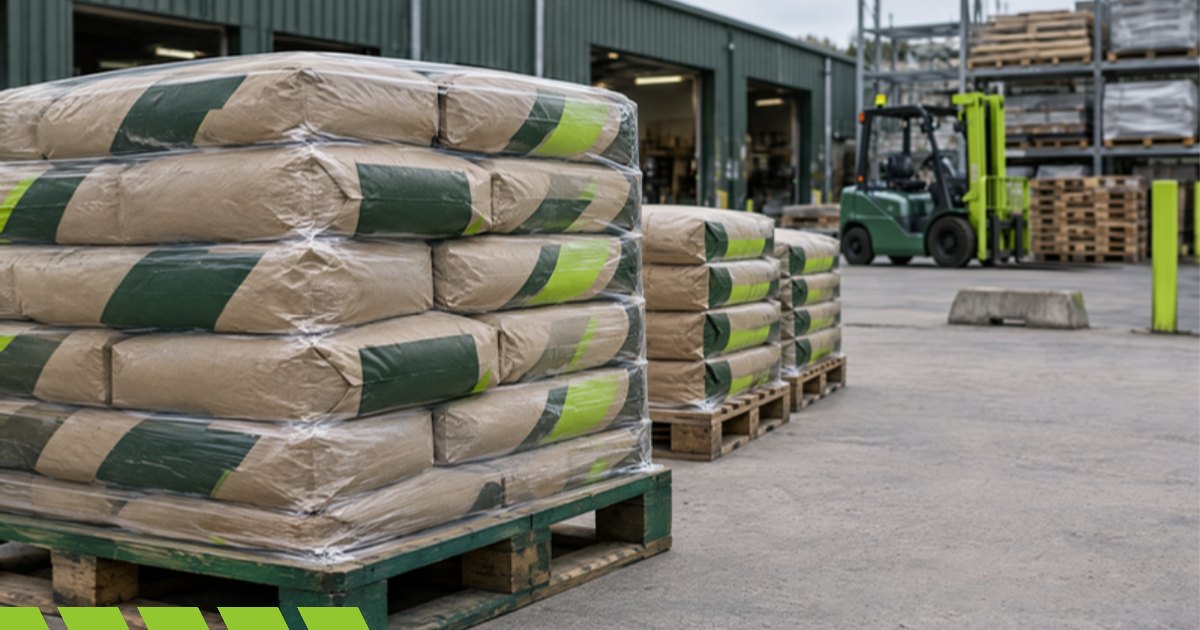
Cement, mortars, tile adhesives, plasters and aggregates reach building sites in bags on wooden pallets wrapped in film. Since 12 August 2026 this packaging falls under PPWR, Regulation (EU) 2025/40. We explain which obligations already apply to producers and distributors of building materials, which arrive in 2030, and what to watch out for in alarmist articles.
Key points
- PPWR has applied directly since 12 August 2026 and replaced Directive 94/62/EC.
- Heavy metal limits in packaging already apply, and the packaging manufacturer must have technical documentation and a declaration of conformity.
- From 1 January 2030 all packaging, including cement bags, must be recyclable, and plastic packaging must contain a minimum share of recycled content.
- From 2030 a share of pallets, crates and other transport packaging must be reusable within a reuse system.
- Penalties for PPWR breaches are set nationally, with a deadline of 12 February 2027.
Cement and mortar bags: recyclability from 2030
A typical building bag consists of several layers of kraft paper, often with a polyethylene liner or coating. Under Article 6 PPWR, from 1 January 2030 only packaging designed for recycling and graded A, B or C may be placed on the EU market. The Commission will set detailed criteria per material in delegated acts. From 2038 only grades A and B will be allowed.
For mortar and adhesive producers this means reviewing the bag design: coating type and thickness, glue, valve and print. Options the industry is considering include mono-material bags (e.g. PE) or paper bags with a barrier that does not hinder paper recycling. Any change must keep the bag strong in transport and protect the product from moisture.
Recycled content in plastic packaging
Article 7 PPWR sets a minimum share of recycled content in the plastic part of packaging. For non-contact-sensitive packaging, such as film bags, hoods and stretch film, it is:
The target is calculated per manufacturing plant and year, using a method set in a Commission implementing act. The regulation provides exemptions, including for packaging where the plastic part is less than 5% of the total weight. A paper bag with a thin PE coating may therefore fall outside this requirement, but this has to be checked for each design.
Pallets and transport packaging: reuse targets
Article 29 PPWR applies to operators using transport packaging such as pallets, plastic crates, foldable boxes, IBCs and pails. From 1 January 2030 at least 40% of such packaging must be reusable within a reuse system, with a target of 70% in 2040. Cardboard packaging is exempt.
A stricter rule applies to transport between sites of the same company or linked companies within one Member State or between Member States: there transport packaging must be 100% reusable. A brick or roof tile producer shipping to its own depots therefore needs a pallet pool: records, returns and condition checks. Barcodes or RFID are not legally required but make it much easier to show the system works.
Requirements for reusable packaging itself, such as number of rotations and reparability, are in Article 11 and Annex VI, and rules for reuse systems in Article 27 and Annex VI.
Minimisation and empty space
Article 10 requires that by 2030 packaging weight and volume are reduced to the minimum needed to protect the product, which must be shown in the technical documentation. Article 24 limits empty space in grouped, transport and e-commerce packaging to 50%. For palletised goods this means rethinking film layers and interlayers.
Labelling and EPR
Harmonised labels showing material composition become mandatory from 12 August 2028 or 24 months after the implementing act enters into force, whichever is later (Article 12). Separately, any producer placing packaging on the market has extended producer responsibility obligations (Articles 44 and 45). In Poland this means BDO registration, records and reports, and for sales to other EU countries, registrations there and, where needed, an authorised representative.
Watch out for inaccuracies
Industry articles sometimes quote specific fines or claim that "every package must be audited". PPWR does not set fine amounts. Under Article 68 Member States set them by 12 February 2027. PPWR does not require an external audit of every package either: it requires technical documentation and a declaration of conformity from the packaging manufacturer. An audit is a good way to prepare that documentation, but it is not a legal obligation.
What to do now: a plan for 2027
- List all packaging: bags, pails, hoods, film, pallets, interlayers, with weights and materials.
- Ask packaging suppliers for declarations of conformity and data on recyclability and recycled content.
- Check which pallet flows are within your company or group (100% target) and which go to customers (40% target).
- Organise pallet circulation records and return terms in customer contracts.
- Plan the bag redesign before 2030 and test new solutions in transport.
- Make sure EPR registrations in Poland and export countries are up to date.
Legal sources
- Regulation (EU) 2025/40 of the European Parliament and of the Council of 19 December 2024 on packaging and packaging waste (PPWR), OJ L of 22.1.2025, in particular Articles 5, 6, 7, 10, 11, 12, 24, 27, 29, 44, 45 and 68 and Annexes VI and VII: eur-lex.europa.eu/eli/reg/2025/40/oj
- Directive 94/62/EC of the European Parliament and of the Council of 20 December 1994 on packaging and packaging waste (repealed by PPWR, subject to transitional provisions)
- Polish Act of 13 June 2013 on packaging and packaging waste management (Dz.U. 2013 item 888, as amended)
- Polish Act of 14 December 2012 on waste (BDO register, records and reporting)
This article is for information only and is not legal advice. Some details depend on delegated and implementing acts the Commission has yet to adopt.